

When we first reached out to Brenda Palmer for an interview, I genuinely didn’t expect a response. Brenda has her hands in so many pies that we assumed it would be a stretch for her to even consider adding us to her already packed schedule. She’s a renowned preacher, producer, podcaster, and author, with a footprint on countless impactful projects and major stages. But in the midst of all that, she still made space for us.
There’s a saying that you should never meet people you’ve always admired from afar—but that couldn’t be further from the truth with Brenda. What you see is truly what you get. That resolute yet warm, honest, and humble spirit isn’t some carefully curated persona for the ‘gram—it’s who she actually is. We chatted over Zoom like old friends; she was disarmingly down-to-earth and present.
Brenda’s influence doesn’t come from her follower count or professional titles—it comes from the undeniable weight of her obedience to God. Her “yes.”
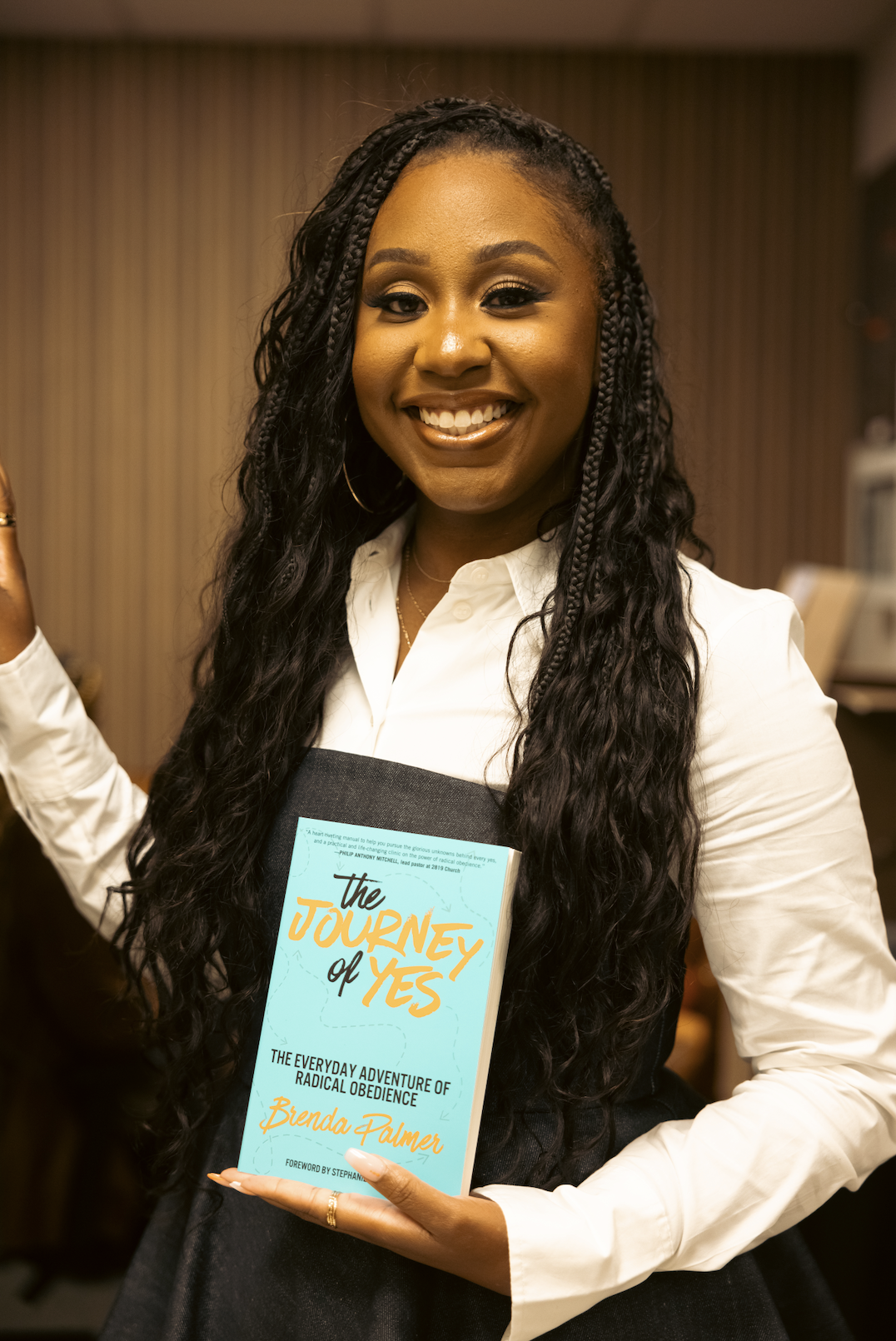
In this interview, I spoke with Brenda about her newly released book, The Journey of Yes: The Everyday Adventure of Radical Obedience, and the rollercoaster of surrender that’s marked her walk with God.
When you’re a preacher’s kid, there is an expectation that you have to do everything perfectly. Your parents are pastors, everybody’s eyes are on you. What was that like growing up and how did you manage those expectations?
I feel like I didn’t have as much of that. My parents were pastors and always served in some level of leadership even before they were pastors. But my parents’ church was smaller, so I did a lot of work. I served a lot. I was the oldest kid in the church.So, I don’t really feel like I always had that pressure. If I did, I didn’t really pay attention to it.
My parents were not always saved. So, they didn’t keep up with any facade. They are really down-to-earth.And I feel like I had a lot more freedom than most preachers’ kids. For instance, if I played sports growing up, I couldn’t miss church consecutively. But like if I had a game every now and then, then my dad would be like, “no, like go play.”
I think they fought for me to have a normal life because they recognized that they chose ministry. I didn’t. And so, I think they were really good at balancing that for me most of the time.
I think the tension for me came where I had to always share my parents. I didn’t get a lot of time with them because they were always serving.And I think not wanting to go into ministry was just because it consumed so much of our lives.
My parents never pressured me to go into ministry, and I’m really grateful for that because that kind of pressure has damaged a lot of people.
Do you think that not being pressured to go into ministry was instrumental to naturally arriving at your “Yes” to God?
I think so. I never really thought about it that way. Although my parents never told me “you need to be a pastor,” I think there was implicit pressure. For instance, I come from a blended family, and I’m the youngest of 10 siblings. Of the 10, I’m the only child they have together.
So I do think there’s a certain level of pressure that comes with that. I’m the child they had once they were saved. And so it’s like there is this unspoken but understood pressure, like “you’re the ‘good’ one, you need to hold it down, right?” I do think that played a role in my decision about whether or not I wanted to say yes to God, because it was my own decision.
I think at age 18, I definitely experienced a level of burnout because ministry was basically our life. It felt like we lived at the church. It was a small church, and they had a grocery store, a community center, and other facilities that fostered a close-knit environment.
We were always at the church. And at a certain point, I was like, “I’m tired of this.” And so I think by the time I turned 18, I was like, “Nah, y’all I can’t do it no more.”
So, I got a job in retail so I could work on Sundays because I was totally over it.I do think having the freedom and not feeling forced did give me the ability to take my own journey.
Ultimately, God was like “you’ll end up where you are supposed to be.” I’m grateful I got to experience a life outside just being completely focused on ministry because I think I value it more.
Let’s talk more about your journey of saying yes to God. Some people are dreamers, others see visions, and some people are more intuitive. How does He speak to you?
God uses my intuition. I have a knowing, and a sensing. Like I will sense that God is saying something and then kind of lean into that. I probably dream, but dreams are not a huge way I hear from God. The Lord will use dreams when there is a dire situation, and he’s like, “I need you to pay attention to this.” In those instances, I’ll get a dream and it’ll be very specific and very undeniable.
But for the most part, I think I get a sense of knowing and I noticed this is from God because it’s so far outside of my natural abilities. I think I’m naturally intuitive, and then I think the Lord just uses that and it’s heightened when it relates to spiritual decisions and stuff.
Let’s take it back to when you left your dream career to follow an unknown future. What headspace were you in at the time?
Well, I’ve had to do that a couple of times. I guess the first time I would say this happened was at the height of my career taking off.
So, I was living in LA, I was at the time working in production at The Potter’s House ONE LA, on a contract basis.
While working at TP as a producer, I started a production company and I took on a contract to produce a show with a popular political correspondent named Angela Rye. And it was during the 2020 elections and we created a show. We got Snoop Dogg to vote for the first time and we filmed it. I felt like I was finally entering a space of like, “OK, this is what I moved to LA for…and things are taking off.”
And then little by little, God started to remove me from those things. I left TBN, and took on a full-time job at ONE while still running a production company and producing The Same Room. And then we started In the Room.
When I took on the full-time position at ONE, I heard God say six months. And I was like, “no, he couldn’t possibly be saying that. Like this is my church. Like this makes sense.” I moved into a new apartment and in six months, I started to feel the transition.
I didn’t know where God was going to lead me. I thought I was going to move to Nashville because I really like Nashville and I went to visit Nashville and the Lord was like, “who told you that you were moving here? And I was like, “well, I thought like, this makes sense, right?”
And I ended up going on a fast and praying for the month of March with Stephanie. And we both had a conviction that at the end of the 30 days, God would make things clear.
At the end of the month on March 30th, I got a random LinkedIn message from a pastor I had never heard of, from a place I had never heard of. And he just says, “hey, I know this is a one in a million chance that you’ll respond to this. But we’re in the process of expanding our senior leadership team and kind of want to know if you or anybody you know is looking for their next.”
It was March 30th and I was like, “this is too random to be random.”
At the same time, I’m reading the message, Stephanie is calling me, asking me random questions. She’s just like, “how would you feel about leaving production and being a small groups pastor?” It was the weirdest combination of things happening.
For me, when we talk about hearing from the Lord in this instance, it’s like I was anticipating for God to respond to something that I feel like he placed in my heart. I got that message on LinkedIN, and then Stephanie asked a related question simultaneously, asking about being a small groups pastor.
Essentially, God had spoken through Stephanie, expressing his will to raise me as a pastor. But at the time, I didn’t know that fully.But it made me pay attention to it because random things like that don’t just happen to me. And so, I’m like, “OK, what are we going to do?” And I went to visit that church for Easter weekend. And when I got there, it was predominantly white.
And I was like, “what’s going on here?” And God’s like, this is where I’m sending you. And so, I got into the interview process, while asking the Lord what we would do. It was a very long interview process. It went on from like April, and I didn’t start the job until June.
From there, well, I watched God’s will unfold.
You asked me where my heart was, and what my thought process was like at the time? Honestly, I wasn’t excited. I didn’t understand why the Lord would move me from LA at the height of my career taking off, to what seemed like oblivion.
I didn’t know anybody. Logically, it didn’t make sense. And to top it all off, God gave the clear instruction “that when you move, leave LA in LA.”
‘Cos anybody who knows me knows that the typical me would move to that church, and every weekend, I would still be in LA taking jobs, because I’m not the kind of person who does one thing at a time.
I had thought about a strategy in my mind. I’m like, “OK, so it’s only a two-hour drive back to LA, I could take out some days to visit.” But God was like, NO. Leave LA in LA.
So, I had to walk away from The Same Room. My production company also became inactive.
Whenever I had doubts, God would give me signs that I was walking the right path. For instance, I was on vacation and randomly, Pastor Toure Roberts (PT) called me. He’s like, “Hey, I just want to check in.” I’m like, that’s random. And then he’s like “let’s FaceTime.” I’m like, “oh, this is crazy.” And it was the day after I had the final interview for the job.
I was a bit ambivalent about the opportunity and didn’t want to have too many expectations. So, my attitude was like, well Lord, we’ll see. And the Lord was like “No, we ain’t going to see. This is what you’re going to do.”
Five days later, I spoke with PT again, and this time, I’m crying. It was hard to walk away from ONE LA – they are my family. They are the only community I had for the most part in LA. So, it was difficult to have a conversation about why I was leaving. I felt like, “Hey, I don’t want to do this, but I feel like this is what the Lord is telling me to do.”
Then PT said something that I repeat all the time:
“Your calling is not a conference call. And if this is what you feel like the Lord is saying to you, then you’ve got to lean into it.”
He was extremely supportive, despite the fact that he would be taking a loss by losing me as a member of the team. I ran production during this period – from the pandemic all the way through to 2021 until I left.
PT said something else I’ll never forget: “This is always home. If it doesn’t work out, you can always come back.” And even throughout the journey, he was still pastoring me while I was at Centerpoint. If I called him or needed anything, he was always present.
That gave me some solace and reaffirmation that this direction was from God.
I took the job in June of that year, and by September, I preached my first sermon. And after preaching my first sermon, they added me to the teaching team. And so, preaching became like a normal part of my job, even though that wasn’t supposed to be my job. And so, the entire time, I thought the church was the assignment that the Lord was sending me to steward. But I later realized that he was using that place to reveal who I was.
Sometimes, God has to move you to a place that will place a demand on things that are in you that you have no idea you had. Because where I was serving previously didn’t have a need for “Brenda the pastor” or “Brenda the preacher.”
I was serving in production. That was the need.
God spoke to me, telling me he had to move me to a place to cultivate and call out of me, the things that I had been running from. And so, when I moved there, I made a decision that I was just going to say, yes. I wasn’t going to run.
I had no idea what that meant at the time, but I decided that whatever the Lord asked me to do, I would lean into it. And it turned out to be preaching. And then later it was going to be pastoring. And then the Lord was like, let’s go again. And I’m like, alright.
What did your friends think about this move? Were they like ‘OK, what are you doing?’ Or were they used to you doing this sort of thing?
I don’t think they were used to it, but I think even if my friends don’t quite understand, there’s a support we all have for each other to follow the Lord. They’ve witnessed my journey from the beginning. My friends have seen me running a production company, being a producer, to being a full-on preacher.
And I think like the Lord always uses Stephanie in my journeys of yes to be a point of confirmation at some level. Before I take the step, she’s going to confirm it. And she’s typically a person I lean on when I’m going like, “OK, this is what I think the Lord is saying.
Here’s what I think I’m going to do.” And she’ll usually be like, “girl, what? you need to go check again.” Or she’s like, “I sense that. It agrees with my spirit as well.”
So, yeah, I think my friends have been really supportive in all of my journeys of yes. Whether it’s like, “OK, you can stay here” or “I have a house in Atlanta. You can go stay there.”
They have been absolute lifeboats. When I would jump into the water and I didn’t know if I could swim, my friends would undergird my journey. Even if they don’t understand it sometimes, they’ve always been present and showing up.

In line with radical obedience, let’s talk about that time that you renounced your sorority membership. I saw all that controversy online and the backlash. How did you cope with that?
Yeah, so oddly enough, I was on an interview like this, for someone’s podcast. And I feel like that week God kept trying to get my attention, and I’m really observant about how the Lord speaks to me.
If there is a particular thing that keeps coming up in different conversations randomly, I’m like, “OK, I think the Lord is after something.” And this particular week, that’s what was happening.
Earlier that week, I was leading a leadership roundup for black voices who are a part of Circuit Riders organization, and they were giving testimonies about their college tours. And one of the testimonies given was from this girl whose mom and dad were in the Greek sorority/fraternity system, and she felt like God was telling her not to be a part of that life.
So, she made a decision not to pledge. As a result, her family basically cut her off. They were like, “only call us for emergencies.” And I’m like, nothing is that serious. That’s crazy! I didn’t think too deeply about it.
So that happened on a Monday. Fast forward to Friday, in that same week, I’m doing this interview, and the woman that’s interviewing me brings up an issue about denouncing or renouncing the sorority she’s a part of. And I got irritated immediately because we were talking about something totally different, and it seemed like such a random topic to bring up.
It was weird because in the process of her asking me about my journey, I almost mentioned that I was in a sorority and in college, God was asking me to walk away and I didn’t. And I don’t know why that was coming up because I never tell that story.
I think even when I publicly renounced my membership, people were like, “we didn’t even know Brenda was Greek.” Because it wasn’t something I talked about all the time, partially because I knew there was so much back and forth about, “can you be a believer and be Greek?” And I didn’t want to be in those conversations. I didn’t feel like I did anything to go against God, but at the same time, I didn’t want to talk about it. So, I never really mentioned I was Greek.
She relentlessly kept bringing up the topic. I don’t think she brought it up as many times as I heard it. But while she was talking, I started saying, “OK, God, what are you after? Like, why is this making me feel this way? Why does this keep coming up?” When we finished the conversation, I asked her what sorority she was a part of. In response, she mentioned that she was a Delta. And I was like, “oh, I’m a Delta.” And she was like, “oh, no, I’m going to send you a podcast.”
She then proceeded to divulge details about the demonic nature of pledging.
She said, “I literally asked an ex witch to read the rituals and the witch said there were commonalities and things that were in her ritual book…” She further disclosed that some pledge verbiage and wordings in the ritual book were verbatim. And I was shocked.
So, then I asked her to send me the podcast. She then mentioned that in addition to sending the podcast, she would also send me a renouncement letter already typed out, and all I would have to do is put my name on it. She’s like, “because we’ve got to get you out of there.” And I was like, “OK, cool.”
I never intended to listen to that podcast because I was thinking to myself, “it’s not that deep.” However, I was leaving the mall one day and the Lord was like, “put the podcast on.” So, I play the podcast while driving home.
About 20 minutes in, I was bawling because there were a lot of things about my pledge process that I couldn’t remember. For instance, I didn’t remember the oath or what we did in the Jewel Nights. So, I didn’t really have a lot of recollection of what I participated in. And Stephanie was the same way. We would talk about our processes all the time, but I just couldn’t remember the rituals.
At first, I was like, well, maybe it’s the Lord wiping it from our memory. But eventually, I realized that it was the enemy keeping it from us. After listening to the podcast, I wrote the renouncement letter, and sent it as soon as I got the chance to.
I repented, and it was crazy because as soon as I came out of covenant with it, God started revealing so much. I started remembering things I said and things I did. Every time I remembered, I would start crying. I was laying on the couch one day watching a sermon by James Aladirin. He was preaching about altars and covenants, and I fell asleep while watching it.
Then I had a dream. I had a vision of my grandfather – it was like a black and white picture – and he had on a uniform, which I would later find out was his “Shriners” uniform. I found out that my grandfather was a Mason.
Afterwards, I called my parents and asked them if my father was a Free Mason. I described the picture I had seen in my dream. And to my surprise, as I was describing the picture, my mom finished the sentence, describing the exact picture I had seen in the dream.
My dad also confirmed, stating that my grandfather was a 32nd degree Mason, which was one step from becoming a Shriner, which is almost the highest degree of masonry. There are only 33 levels in Freemasonry, and he was at the 32nd degree. After that revelation, so many things began to happen in my family. My dad randomly had a stroke. Then he overcame cancer.
I have a brother who has the same name as my father and my grandfather. And right before he stepped into his career, he had a failure of health, which nobody could explain. And I’m like, “hey, guys, I think there are some things here in our bloodline that we need to reverse.”
Also, I began to pay attention to every woman in my family – like, immediate family, sisters and aunts, and I uncovered a pattern – either they were divorced or single. There is not one sister or, like, female in my family that is married.
Steph and I say all the time: If there’s a pattern, there’s an altar somewhere. And and the moment God started revealing more things, my dad started having issues with his eyes and I’m like, this is demonic.
During the timeframe that we had begun to start seeing patterns that were running in our bloodline, all these weird things started to happen. My dad’s vision suddenly began to fail as well. I told my family that we could not pretend like this were all surface level incidents.
I soon came to a realization that these sororities, fraternities and the like, had more to them than was being portrayed. Why are these organizations strategically planted when we are college-aged? It’s because you’re in adulthood, and it’s the first major decision you make and usually at that stage, most people are not spiritually mature enough to ask questions.

The Greeks are the most lively people in the yard and you just want to be in a group that looks cool you know? Everyone wants to be outside having fun.
But nobody’s thinking like, “well, why are we actually doing this other stuff like taking off our shoes and going through a purification process before we kneel, and things like that? If all of this is normal, why is it secret?”
So, for me, renouncing my membership from the sorority was a step of obedience because it was what the Lord was asking me to do. This experience made me realize that we had all been deceived, and I felt like people needed to know the truth. So, I spoke boldly about it on a podcast.
And I think like I was a little jarred not by the backlash, but where the backlash came from. Don’t get me wrong. I expected to be fighting because I exist between faith and culture.
So, I expected to have a lot of conversations about my stance with my friends from the culture. Interestingly, they were actually the most understanding. Not everyone was accepting of my perspective, but they were understanding.
They were like, “I don’t know if I agree with that, but I feel you. You know what I’m saying?”
Oddly, I felt like I was fighting with the church on this matter, and it just did not make sense to me that most of the backlash came from the church. I mean they were doing opinion articles, podcast videos… it was just a lot.
In addition to the overt attacks, there was implicit condemnation as well. I noticed that people I had really good relationships with were kind of distancing themselves from me. And I recognize that it was also an attack from the enemy, because the entire time I was going through that, I was writing this book.
Due to the controversy, I was in the middle of regretting steps of obedience. But then, I was writing a book about how important it is to be obedient. It was a challenging time. I was like “Lord, I feel like you told me to do this. Now people are dragging me.” It was tough.
I was confused about why the backlash was so intense, as I was not the first person to have ever publicly renounced membership from a Greek society. Why was this going viral? I guess it was because I appeared to be a “pastor” who was speaking so publicly about the issue. So people were like, “I’m so glad that pastors are finally speaking out about this.”
In response to this notion, I was like, “first of all, I’m not a pastor, and if that’s why y’all are blowing this up, y’all should stop, right? During that period, I would see pastors do Instagram live sessions, expressing opinions along the lines of “oh it’s not that deep. You have a liberty. It’s not demonic.” Well, yes, it is.
Some of the Greek gods that are attached to these organizations are listed in scripture as idols that the Lord was not happy about his people serving. The scripture says that all things are from the Lord, to the Lord and for the Lord, for his glory. Now just ask yourself: Do things you do in these organizations edify God? Does this lead people to Jesus?
Do y’all think it’s a coincidence that pastors and bishops and leaders are engaged in these things? No, that’s intentional. Satan didn’t have to disrupt the church because most of us were in covenants with Satan unknowingly.
And there were just things that the Lord did not walk me into, even spiritually, because of that. Because God honors covenant, whether it’s with him or against him, He honors covenant. There are some things I didn’t experience until I came out of the covenant.
I think the Lord used that situation to also deal with idolatry in my heart. He’s like, “you’re cool with being obedient, but are you only cool with being obedient if everybody’s OK with it? How about the times when your obedience may cause backlash?”
Often times, we’ll say, “God told me to do this,” but we don’t actually believe it was God until someone else affirms it. But what if no one affirms that step of obedience? Does that mean it wasn’t God just because they didn’t understand it? Or can you trust that it was God—because you have a relationship with Him, you know His voice, and you’re learning to lean into it?
Something I always say is: People aren’t always going to get it. But just let your fruit speak.
That’s what you’ll find in the book. You’ll see me taking a lot of steps that, at the time, didn’t make sense to people. But later, they look back and say, “Oh, okay… we get it now. That was the Lord. Got it.”
For women who wish to say “Yes” to God, but feel overwhelmed about the idea, what are some small daily steps of obedience they can take, as they learn to lean on God?
I think the journey of yes is often portrayed as these big, massive steps—but really, it starts in your everyday life.
It starts with the simplest things. And honestly, I’d say those steps are radical too, because they go against what you’d normally do. Like something as small as paying for the coffee of the person behind you, even when you’ve got a million things to do and you’re thinking, “I don’t have time for this. I’ve already been waiting in this coffee shop forever.” But you pause, and you buy their coffee anyway—because who knows? Maybe they’ve felt unseen. Maybe they’re fighting for their life. And in that moment, God wants to use you to show up and demonstrate His love.
Sometimes we get overwhelmed because we think obedience has to look like something huge—like moving across the country, or starting a ministry, or preaching the gospel online. And sure, sometimes it’s that. But sometimes it’s just waking up and reading your Bible. That alone is an everyday adventure of radical obedience—because let’s be real, you want to grab your phone and scroll Instagram the moment you wake up. Yet today, you chose differently.
For me, the everyday adventure of radical obedience looks like waking up and asking, “God, what do you want me to do today? How can I live surrendered today?” And sometimes, it’s as simple as not clapping back when someone gets on your nerves. Just choosing to be quiet. That’s radical obedience too. That takes a lot of restraint. That’s a whole, “OK, Lord.”
What I hope you’ll see in the Journey of Yes is that—yes—sometimes it involves these big, bold moves. But God only trusts me with those because I’ve said yes in the little things. Like choosing not to go somewhere. Or choosing to forgive. I think a lot of us can start right there—just choosing to forgive the person who hurt us, and loving them the way God loves us.
In this season, for me, it has looked like having tough conversations. Figuring out why people are upset with me. Pursuing peace. Apologizing for things I didn’t even do—just because that’s what the Lord is asking of me.
That’s the journey of yes.
Even today, I have another podcast interview, and there’s something the Lord wants me to share. And I’m like, “I don’t want to talk about that. That’s my business.” And He’s like, “Great. Love that. Now it’s going to be our business. And I’m going to use it to set someone free.”
So, I think we’ve got to let go of the misconception that saying yes to God only looks like these huge leaps into the unknown. More often, it’s just waking up and choosing to say yes—in whatever way He leads.
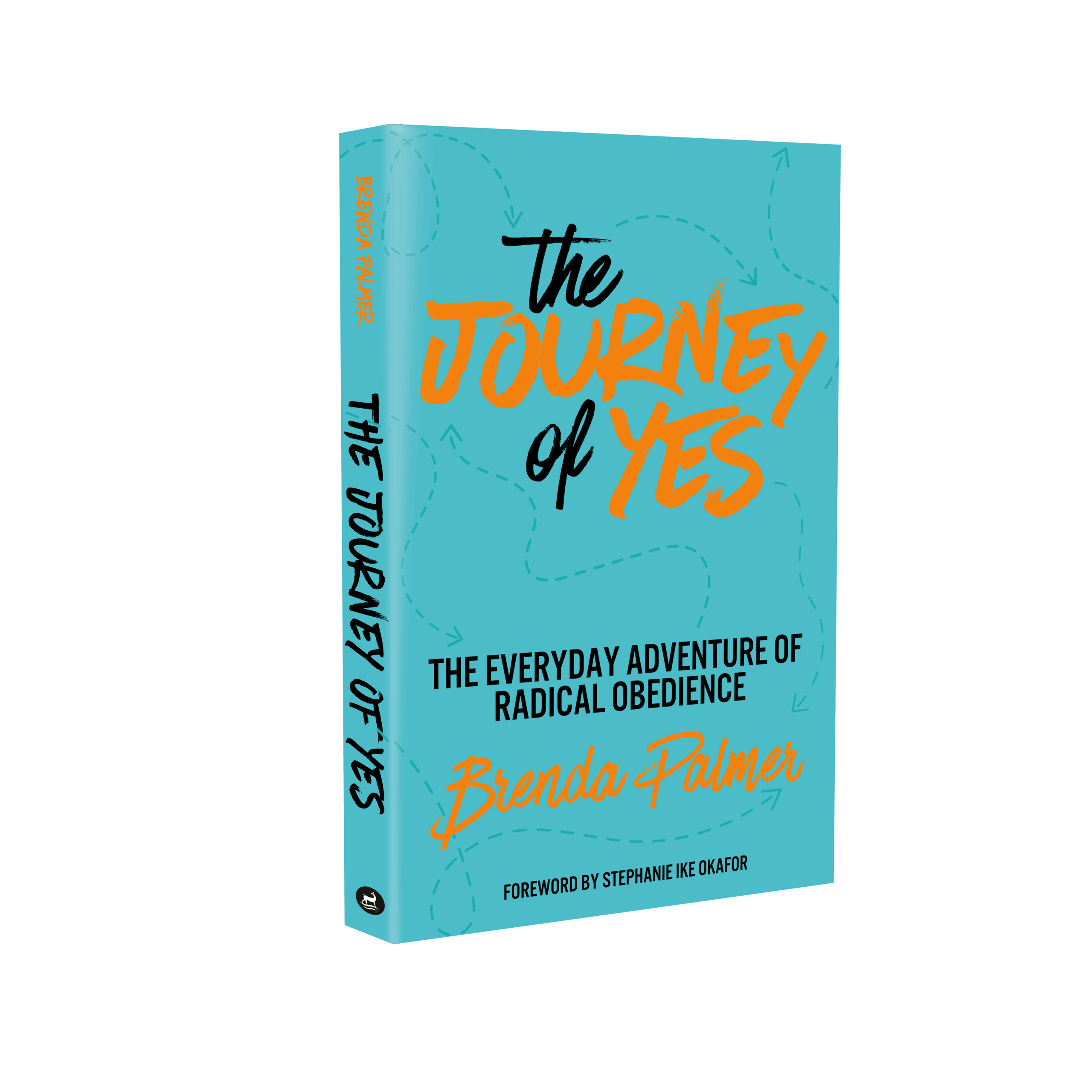
Tell us more about your book, ‘The Journey of Yes.’ Who is it for? Is it for people who are already saved? Or is it for everyone?
I think the book is for everybody—like, that’s my heart. It’s funny because the publisher was like, “You can’t use the word ‘radical.’ People aren’t going to like that word.” And I was like, “I don’t care. That’s what it is.”
I think we’ve got to stop baiting and switching people—that’s the real issue. We sell them this cookie-cutter version of faith, and then they step into it and realize, “Wait, this is hard.” And I’m like, “Yes! Open the first page of this book and be like, ‘What is this?!’” Because we’ve got to stop sugarcoating the reality of walking with God.
So, I think this book is for anyone who’s trying to figure life out. Anybody who’s in that “What’s next?” season—which honestly, is all of us. What’s next for today? For my life? For my relationships?
Whether you’re saved or not, the beginning of the book starts with “How do I hear the voice of God?” Because I use that language a lot throughout—like “I heard God say…” So, I walk through the story of Samuel hearing God’s voice for the first time, and I break down practical ways we can become more aware of how God speaks—because He speaks to all of us.
I really think this book is for someone in transition. Maybe you just finished college and you’re wondering what’s next. Maybe you feel like God’s calling you to move, but you have no idea how to take that first step. You’ll see a lot of that in the book. And for someone who just said yes to Jesus and has no idea what that means or looks like—it might feel a little jarring at first. You might be like, “Wait… He’s going to ask me to do what?” But that’s real.
Even something as simple as starting my podcast—it felt like just a creative idea. But God used it to heal me, to deliver me from things I had never shared with anyone. I thought I was doing it to help someone else, and God used it to uproot stuff that had been dormant in my heart for years.
So, if you’re asking, “What does this journey of yes actually look like?” or “I just chose to follow the Lord—what now?”—this book is for you. Whether you’re a new believer, someone still figuring out what you believe, or someone who just wants a glimpse into what life with Jesus really looks like—I believe this book meets you there.
Honestly, I think anyone who takes the risk of picking it up will find something they need in it.
Can you talk about your passion for suicide awareness and prevention? Did this passion stem from any personal experiences?
Yeah, so I do have a personal story—I talk about it in the book. I moved to LA right after experiencing a deep betrayal from my pastor back when I lived in Chicago. And the way I dealt with it? Honestly, not well.
I’m getting better at it now, but I’ve always had a tendency to internalize things—often for the sake of protecting other people, but at the expense of myself. Like, “If someone else knew about this, what would it do to them?” So instead, I’d just carry it. But that ended up costing me my own sanity and mental health.
Because I internalized so much, there were a lot of things I never actually dealt with. And once I moved to LA, I started getting triggered. Reality began to set in—people had made their decision, and I had to start my life over. I hated that. I was angry. Really angry. I damaged a lot of relationships just because I didn’t know how to process the pain and hurt that I was carrying.
By 2019—about a year after everything happened—I fell into a depression so deep I didn’t even realize I had been lying in bed for five days straight. I had a roommate at the time—she’s one of my best friends now—and she knocked on my door every single day.
What I now have the language to describe is something called passive suicidal ideation. It’s that feeling of having nothing to live for, so you just stop living. I think if it had gone on much longer, it could have led me to take my life. I’d never felt so hopeless.
And because the hurt was tied to church, there was a part of me that felt like, “God, you left me out here.” Like, I made it through all of that… but now what? I was picking up the pieces. I couldn’t find a job. I was struggling. It just didn’t make sense. I had given up hope.
But my roommate didn’t stop knocking.
Eventually, I came to myself. I realized I’d been in that bed for five days, and I was like, “this is wild.” She was like, “Hey, you want to come out and watch TV?” Just something simple. “Whatever you gotta do—just come out of this room.” So, I took a shower, finally, and came out. We sat on the couch. Then she said, “You want to get ice cream?” I said, “Sure.” So we went to get ice cream. Then she’s like, “Wanna go walk around the lake?” I was like, “Okay.”
And the moment we got to the water, I just broke down. I started crying and finally letting out everything I had been holding in.
Looking back now, I obviously see it was my friend knocking, but that’s exactly how the Lord pursues us. And I carry a burden for that—especially for creatives. Because I think so many of us find our value in what we do. And when we don’t have the opportunity to do, we start to question whether life is even worth living. Like, “who am I apart from that?”
But one of my passions is to help people see the truth: The fact that you have breath in your body means your life already matters. Your mere existence is a contribution to this world. Even if you never do another “big” thing—just waking up and breathing is enough of an offering.
So, whatever I can do to amplify that message, I will. Because I’ve been the person who suffered silently, who didn’t have words to articulate what I was feeling. And now that I’ve started being vocal about it, I’ve seen how it gives other people permission to do the same.
There’s this misconception sometimes that because I’m a person of faith, I don’t struggle.
But that’s just not true. The gift of faith isn’t that I don’t struggle—it’s that I don’t have to struggle alone. Faith means I get to invite God into it. But that doesn’t mean the pain disappears.
It’s really a part of my mission—because I genuinely care. Whenever I hear about someone dying by suicide, it breaks my heart. I think, man, they must’ve felt like they didn’t have anyone they could talk to—anyone who could yank them out of that place.
And the truth is, sometimes suicide starts as a seed—planted by the enemy—that tells you your life isn’t worth living. If you sit with that seed long enough, if you meditate on that lie, you can end up making a decision that’s completely outside of who you truly are.
So, whatever I can do—however I can encourage someone—I want to say: There is so much better on the other side if you just hold on. Don’t give up in the fight.
I’ve been through so much, and I look back now and think, I almost didn’t live to see this. I almost didn’t live to see this book come to life and be released into the world. And that thought wrecks me in the best way.
So, every time I get to live a moment like this, I’m just like, Thank you, God. Thank you that I get to be here to see it.
Tell us more about your other activities, and how readers can keep up with you
Yeah, for sure. So, I have an initiative called Come Alive Collective, and it is really about creating spaces where people can encounter the Lord and build authentic community. It’s been beautiful to see how it’s all unfolding.
We meet every Monday. There’s also a virtual community that gathers a bit earlier—mainly because they’re on the East Coast or in other countries. I’m based in LA and we meet at 7:30pm PST, which, let’s be honest, is when most people in other time zones are already asleep. But we stream it on YouTube, so anyone can join.
If you go to Come Alive Collective on Instagram, there’s a sign-up link for the virtual group. That side of the community is led by three amazing leaders I’ve had the privilege of raising up. They rotate leadership, set monthly themes, and really just hold it down. It’s incredible to watch them thrive.
As for the in-person Bible study, I host that here in LA on Monday nights, and we also stream those sessions on my YouTube channel at I Am Brenda Palmer. We leave the replays up each week, and it’s been such a gift. So yeah—that’s happening weekly until the Lord says otherwise.
As for the podcast… I’ve been on a break focusing on all things book, I wasn’t sure about returning to podcasting. Life is full—like, I have 10,000 things going and I’ve been seeking the Lord on whether it’s something to return to or pause. I know nobody wants to hear that, but I really want to be sensitive to what God is saying about the podcast. I am excited to say we’re gearing up to shoot season 8 of “Life in Perspective.
__________
To get copies of Brenda Palmer’s The Journey of Yes: The Everyday Adventure of Radical Obedience, visit iambrendapalmer.com
